Construction
The long call butterfly is the combination of a call bull spread and a call bear spread. It involves three different strikes and it consists of a long ITM call, a long OTM call and two written ATM calls. The two long calls strikes should be equidistant from the middle short calls strike.

It is a debit spread because the money we have to pay for the long calls is more than the money we earn from the written calls.
When to use
When we expect that the price of the underline security will not move much in either direction. Preferably we want the underline security to be exactly at the middle (ATM) strike in order to achieve maximum profit which is limited. Maximum potential loss occurs when at expiration the price of the stock is at or above the higher strike or at or below the lower strike.
It is not an easy strategy to implement because someone must predict with great accuracy the price of the underline at expiration and the stock must stay relatively stable for the time horizon of the trade, which is quite difficult in today’s volatile markets.
Notice also that the goal in the long call butterfly is the same as in the long put butterfly and the short straddle (the price of the underline security at expiration must be exactly at the ATM strike or near it).
Loss/Profit at expiration
Maximum loss: Net premium paid + commissions.
Maximum profit: (Middle ATM strike – lower ITM strike) – net premium paid – commissions.
Profit/Loss diagram
Below we can see the profit/loss diagram for the long call butterfly strategy. We are long one ITM call with strike $23 and premium $2.50, one OTM call with strike $27 and premium $0.50 and short two ATM calls with strike $25 and premium $1. At this particular example the maximum potential gain at expiration is equal to the maximum potential loss, but this is not always the case.
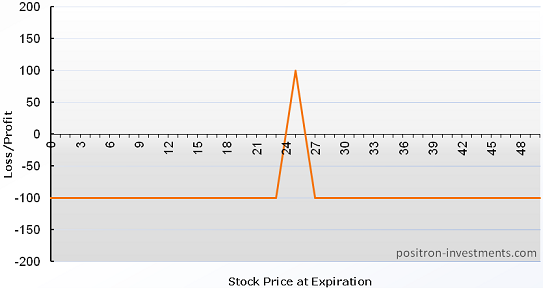
Long call butterfly strategy example
In the daily chart of FCX (below) we have spotted a support (line 1) and a resistance (line 2) which, as we postulate, will hold the stock within a range for the short term. Price now is at $34.34 (point A) and we believe that for the next two weeks it will remain relatively unchanged near $35. We don’t expect any important news about the company. We can buy one ITM call with strike $31 and premium $3.80, one OTM call with strike $39 and premium $0.20 and write two ATM calls with strike $35 and premium $0.70. The aggregate premium we have to pay is $260 {[($3.80+$0.20)-(2x$0.70)]x100}.
If the price of the underline at expiration is exactly $35 (ATM strike), we accomplish the maximum profit which is $140 {[($35-$31)x100]-$260}. If the price at expiration is let’s say at $37, then the two short calls will be exercised against us and we will have a loss of $400 [($37-$35)x200]. The long lower strike call is ITM and by exercising it we will have a profit of $600 [($37-$31)x100]. The OTM long call will expire worthless and cannot be exercised against us. So, we have $600-$400=$200 profit minus the net premium we paid for the opening of the position which is $260, we have a final loss of $60 plus commissions.
In this example the maximum profit we could achieve is $140 minus commissions and the maximum loss we could suffer is $260 plus commissions, if the stock price at expiration is at or beyond the higher or lower strikes.

 En
En Gr
Gr