Positron Investments

Trading & Education in Options, Futures, Stocks, Forex
  • Home
  • Technical analysis
    • Technical analysis basics
    • Candlesticks patterns
  • Options
    • Options basics
    • Options strategies
    • Binary options OTC
  • Futures
    • Futures basics
  • Forex
    • Forex basics
  • Market View
  • Contact
  • el

Options basics

  • What is a call option
  • What is a put option
  • Option expiration
  • Option strike price
  • Option premium
  • Moneyness
  • Option buyer vs option writer
  • Options positions
  • American & European style options
  • Intrinsic value & time value
  • Volume & open interest
  • Options chain
  • Payoff & profit diagrams
  • How to interpret a payoff-profit diagram
  • Historical volatility
  • Options pricing
  • Implied volatility
  • Sensitivity factors (Greek letters)
  • Greek letters: Delta
  • Greek letters: Theta
  • Greek letters: Vega
  • Greek letters: Rho
  • Greek letters: Gamma
  • Position Greeks
  • Put-call parity
  • Trading options

Put-call parity

Put call parity describes the relation between European calls and puts of the same underline security, with the same expiration and strike price. Below is the mathematical formula which describes it:
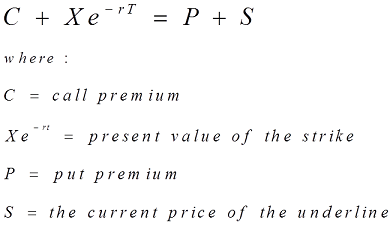
So, the call premium plus the strike price equals the put premium plus the current stock price. We can see that by using the put call parity we can construct synthetic positions which involve the stock and its options and having the same profit/loss profile as the original position. If for example we isolate the call on the first side of the formula we will have a synthetic call:

The above relation tells us that the profit/loss of a long call is equal to the loss/profit of a long put plus the stock minus the strike price. So, by being long in a put and the stock it is like being long in a call.

If we isolate the put premium then we have a synthetic put:

The above relation tells us that a long put is equal to a long call and the short selling of the stock (minus sign in front of S). So, by being long in a call and short in the stock, it is like being long in a put from a loss/profit aspect.

In real markets discrepancies can be observed and the two sides of the put call parity don’t exactly match. 

Links

Recent posts

  • Possible breakdown in Greek stock exchange
  • Application of a simple strategy in EUR/USD
  • S&P 500 runs out of fuel
  • Short term downtrend in Greek stock exchange
  • Possible upward movement in S&P 500

Blog categories

  • Day/swing trades
  • Economy/Politics
  • Trading signals
  • Trading strategies

About Positron

Curriculum vitae
Sitemap

Share

Donate


(Currency: USD)

Copyright © 2018 Positron-investments.com - All rights reserved.

  • En En
  • Gr Gr